
Avoiding Graphs and the Colour of Fishing Tackle
Original Date: August 2016
Updated: September 2026
“Investment management is best illustrated by the story I tell about the guy who sold fishing tackle. I asked him, ‘My god, they’re purple and green. Do fish really take these lures?’ And he said, ‘Mister, I don’t sell to fish.’”
The decision of where one invests their capital is the single most important decision related to (financial) wealth creation, yet most people invest in assets and after the fact cannot explain why. It may be because their advisor told them to, or maybe a friend, but I'm too curious of a person to accept the notion that the reason why people make these decisions is laziness, blind trust, or to a lesser extent ignorance. It is more often the case that someone already has a day job and is not interested in doing their own due diligence, or even learning about investing. It seems that the day job and the stresses of everyday life lead to general fatigue and an unwillingness to learn about a wide variety of topics outside of the field one works.
The investment management industry leads to investment decisions with almost no chance of providing a meaningful return, or generating real wealth, over the longer term. The term 'meaningful return' here is defined as returns large enough to replace actual hours of work in day-to-day life.
The Questionnaire
Most investment advisory sessions will first begin with a basic questionnaire, where the advisor will ask about a client's retirement goals, risk tolerance, and give some information on financial planning related to tax items.
By far, the most interesting aspect of this discussion is the idea of identifying the risk tolerance of a client, and then attaching some sort of expected return (more specifically, a percentage) based on this assessment. I find the idea of creating a connection between a risk tolerance and expected returns to be strange, but it is essential to the methodology of the mainstream investment industry. Once the client agrees to this risk/return percentage, a reference point is established psychologically, and the client will not be easily convinced to deviate from this expected return. By the client agreeing to this percentage, he has (unknowingly) committed up front to accepting mediocre returns for the foreseeable future.
Risk vs. Reward
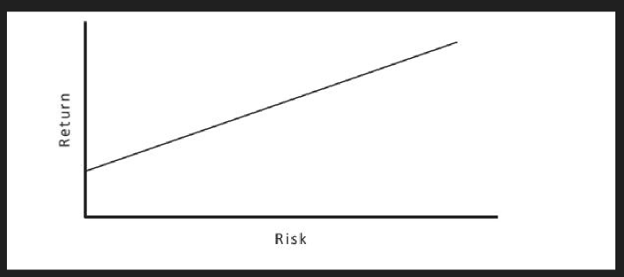
In investment circles, a graph is often used to illustrate the relationship between risk and reward: the more risk you take in an investment, the more reward you should receive. Different asset classes will typically fall into different points along the graph. For example, the money market will be at the far left, considered to have almost no risk. Accordingly, venture capital, which represents pure start-up investments, would be all the way to the right. The amount of outcomes that can occur, which would result in losing the investment, increases dramatically as you move to the right of the graph.
Unfortunately, it seems that this graph has done a lot more in creating an expectation of return based on one's perception of the risk, rather than reflecting actual returns in practice. In reality, we cannot know what will take place in the future, including the exact risks associated with the investment. Howard Marks has often written: "If riskier investments could be counted on to produce higher returns, they wouldn't be riskier."
Digesting this sentence should cause a re-evaluation of the entire graph above. An investor should start to realize that this graph is based on some type of probability structure that does not always reflect reality. For example, investments which are riskier can produce mediocre results (not just total losses or large gains); and investments which are safer can produce exceptional results (as well as total losses). These examples have occurred historically and completely work against the above graph. In both cases, the investor is either correctly or incorrectly judging the potential outcomes of the investment (or is getting lucky, which is the topic for another day).
Yet, the structure of the investment management industry rests on this graph being true. It doesn't seem logical that a person would agree to, say, a 6% return, but on the whole they are being told that this return coincides with the "right" amount of risk. It is also not logical that a client is being told that they will achieve this return as if it is in some way controlled by the advisor (hence the client is told that there is a "target return"). But, you wouldn't want your advisor to tell you in your meeting that he has no control over anything. It's much better to be told that you "will" earn X if you invest in Y product. Sure, you "know" this is not a sure thing, but a variation in the return will still feel like a violation of a concrete plan that you made.
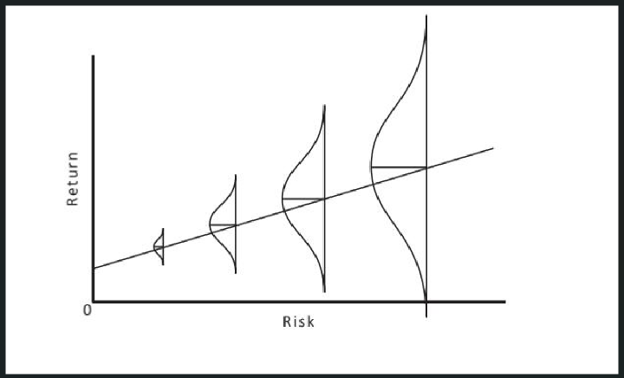
Howard Marks' graph for risk vs. reward is a much better indicator of the realities of this relationship. When you receive an investment opportunity, it seems to be a lot more like a vertical line drawn across the risk/reward line, showing the variety of outcomes which can occur at each level of investment. The key is that we can't know the risks prior to investing, so this graph is a lot more reflective of what we see when we are presented with an investment before the events occur.
Returns for 'Capped' Investments
For certain investments, returns are, for a lack of a better phrase, 'man-made'. While we can't know the risks associated with these investments, the returns can be somewhat predictable. Returns are priced, similarly to the way we appraise residential homes. A corporation issuing bonds will price their interest rates comparably to other competitors in its industry; banks set their dividend yields relative to each other, and so forth. There is no (or specifically, there can't be) a correlation between the return we set in the market and the actual risk being taken.
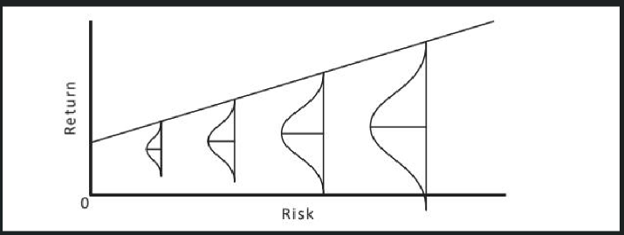
The most important quality of these types of investments is that their returns are effectively capped. If you buy a fixed income security paying a 5% coupon, it is very unlikely you will receive more than 5% on your investment, but there are still outcomes which can occur that would cause total losses. Losses on securities like these seem unlikely to occur, but that does not change the reality of the exposure. The most recent example of this was the financial crisis in 2008, where investments that were marketed as less risky lost all of their value. (Note: We convince ourselves that this type of event is 'once in a lifetime' and unlikely to happen again. However, as Warren Buffett has said, consider that an event which occurs once every 30 years has a 30% chance of occurring every 100 years. If you think that you will be investing for 50 years, this should change your outlook on the likelihood of a negative event occurring in your investment lifetime.)
Effectively, these investments are exposed to the same risk of loss, but we accept a limited reward. The underlying point here is that there are investments which have almost no chance of returning something that will be meaningful. These investments function within a world where there is no event which can occur that will positively impact your position. Conversely, there are events which can do so negatively.
Some investments which fall into this category are nearly all fixed income funds, most corporate bonds, most mutual funds (particularly those sponsored by major banks), some hedge funds, certain income producing real estate, and mortgages or loans of any kind. I am venturing a guess here, but I believe that most people have some or all of these in their portfolios, and that an advisor (or an idea influenced by the financial media) recommended them.
The recommendation was likely made on the basis of safety, or capital preservation (and almost definitely with the best intentions). However, in reality, what occurred was the transferring of hard earned capital in the form of cash to 1) a fee for the advisor and/or trader broker; and 2) a scenario where 100% of the remaining capital is exposed to loss in exchange for the possibility of earning a return slightly above inflation.
I am repeating, fundamentally, the same point that John Bogle (Note: Bogle founded Vanguard, the first ever and now the largest index fund business in the world, and has written many pieces on, depressingly, how the entire stock market is a loser's game.) has shouted at us his whole life. An individual who pays a consultant a fee to earn the same returns as the market will necessarily have returns that will be less than the market. He has to. If I hire a manager who gets paid a 1%–2% fee, and the market returns 6%, I have to earn 7%–8% just to earn what I would have if I didn't hire him in the first place. As it happens, these managers over the long term don't earn more, so I will more than likely end up making less.
This is not a new discovery, especially as we sit here today in 2026. However, I do believe that this becomes doubly offensive in the case where individuals have more ambitious retirement goals. If money is being invested in fixed income or similar products, the individuals with these goals may not even know that the product itself could never deliver.
Investment Management
All of this begs the question of why any individual would invest in capped investments versus un-capped. This is a topic for legitimate debate, but in my experience this is driven by 1) investment managers and advisors who are not typically paid for performance and are incented mostly on the total assets under management; 2) the angst around investing, particularly in things which are difficult to understand; and therefore 3) investment managers cannot make investment decisions that, in retrospect, would look irrational to clients. (Note: Most successful investors mention that if we are not investing in situations that would, in retrospect, look foolish, we cannot be successful.)
Funds with the goal of growing AUM only ensure the assets are exposed to situations which are common, appear similar to other funds which have been successful, and appear less risky. This would be something critical to the strategy because of the way we are made to understand risk and reward. I could then explain that my returns will be superior to other funds, because my investing approach is slightly different than my competitors, or I have a good track record and so forth. If my actual results differ negatively from the initial plan, I would just explain to the client that the market is volatile and that they should be more patient which, depending on the time frame you are looking at, will almost always be true (Note: Consider that the market is advancing 10% for the year. As a client, you are unlikely to complain or be worried, therefore, you will not likely want (or care deeply) about an explanation for the annual gain. Consider next that the market is declining 30%. As a client, you will call your advisor and complain, probably asking to sell in a panic. You would then be well served by being patient and waiting for the market to recover, which is what the manager will rightly tell you. In either case, you will be advised to be patient and stay invested.)). In retrospect, the investment portfolio would seem like it made sense at the time, so I can probably keep my fund in operation.
The structure of the industry is to link commercialized funds with safety and proper investing strategy. The manager can promise (with the best of intentions) to deliver outstanding returns, however, it would be a challenge for them to do so without investing in situations which are harder to explain and appear riskier. So, the manager must throw out his original ideas and focus on what sells.
To put this idea another way, as clients, it is difficult to agree to invest in the types of investments that would provide meaningful returns because of how they appear — for example, an investment in a small private business or start-up. Instead, we would probably prefer to believe that the same products which everyone else is investing in will yield better results. Charlie Munger summarized this best: "I have a friend in the investment business who is offering his investors 20% returns, and when I told him you know you can't achieve that, my friend says well if I tell them less, they won't invest."
Expectation of Return
It is a common rationale in the financial media that in order to achieve greater financial rewards, we should take on more risk. The expected return is set at some nominal amount of around 6% and how far someone is willing to deviate from the norm is packaged up and explained to us as our 'risk tolerance'. I question whether or not the concept of 'risk tolerance' is even real. It may just be that there are investments worth making and others that are not. In any case, this is where the angst comes in. We are told by an authority that 6% is what we should expect, and that anything higher exposes us to more chances to lose the money we are investing. The options being presented, in a nutshell, are: make 4%–6% and keep your money or try to make more and probably lose your money. Put this way, few people would choose the second option. The idea that we take more risk in a mortgage investment corporation than in a Canadian bank stock because the former is paying a 10% yield and the latter is paying a 5% yield should not reflect one's view of risk in any way. But, this is the dominant thought and is regularly the basis for investment advice. (Note: I can understand that there would be a counterargument here: those investment advisors would say it's the other way around. I.e. they would say because it is safer, the investment can offer the prospect of a lower return. My point here is that the expectation of return is so closely tied to the general idea of risk, that it has become common to say that someone who invests in situations with higher possible returns is more of a 'risk taker', when this may not be the case.)
Sidecar Investments
Economist and Harvard Professor Richard Zeckhauser coined a concept in an essay titled "Investing in the Unknown and Unknowable" (Note: In my view this is probably one of the most important pieces ever written on investing.) called Sidecar Investments. There are certain people who have what Zeckhauser calls complementary skills, such as a real estate developer. A developer who made a great fortune in real estate did so because he knew where to look for property and how to build something that would be sold. The returns that these successful developers earn on their investment will be higher than average real estate yields because of these skills. Zeckhauser explains that there are certain situations where we can benefit from someone else's complementary skills. Every so often we will be presented with the opportunity to invest alongside these people where our terms and conditions of the investment will be the same as theirs.
Here is an excerpt from the essay: "The investor rides along in a sidecar pulled by a powerful motorcycle. The more the investor is distinctively positioned to have confidence in the driver's integrity and his motorcycle capabilities, the more attractive the investment, since its price will be lower due to limited competition."
It is important to note that I do not mean to recommend that you invest with a person you feel you know or take the next 'hot tip'. Rather, the market's view of what is risky is not as important as finding superior managers who have the ability to get involved in situations where there is less competition. This is where there will be a price advantage.
Finding these types of situations will challenge the investor to find superior managers and rare information that will more likely create unique investment opportunities. This may be a better use of time then developing views on the stock and real estate markets, or reading about rare start-ups that have become huge worldwide successes.
On Being Ignorant
I have a friend who jokes about how he doesn't know or care about any of this stuff (he would be the 'lazy' person I refer to in the opening paragraph). He constantly says he needs to learn more, or educate himself about investing and have a better understanding of where his money should go. If the investment management industry has proven anything it is that outside of subjects like taxes, increased "knowledge" about how to invest or where to invest does not help generate wealth. We can be totally ignorant of the risks we are taking and still make extremely lucrative returns, or we can research as much as possible and still lose. In fact, we are not even aware of the risks we are taking when we make these investment decisions. This is one of the reasons why so many investment managers can have a strong five years followed by a five year stretch that puts them out of business. (Note: These points are made several times in the works of Nassim Taleb and Daniel Kahneman.)
More information does not mean less risk. If you are a professional poker player you can still lose to a guy who doesn't even know how to play.
Within the context of sidecar investing, we may sometimes be ignorant of the investment industry, but most of us are a good judge of people. It is really interesting, in this case, to ask ourselves if our feeling around a particular person and whether or not they will be successful is any more of a legitimate reason to invest in something, than to invest based on our advisor's view of the macro economy.
Hobo-Advisor
The next and concluding thought might be, "Isn't my advisor the expert? And isn't the investment I have made with him the sidecar investment?" This depends on whether or not the advisor actually has complementary skills, and whether or not their investment fund structure allows the advisor to use them. Certainly, there are many skilled investors who have made clients meaningful returns, and there are also many of them who have this potential, but have been stuck in structures that don't allow them to be creative. I believe that selecting an advisor correctly is a skill in its own right and should not be overlooked as much as it often is.
If I was choosing an advisor, I think that I would first ask myself this question: If the advisor sitting in front of me worked alone in a horrible looking office, located in some horrible neighbourhood, had no company logo, and was dressed terribly, would I still invest my future with this person? (Note: Put another way, I would ask myself how much I am relying on a brand, or the firm's presentation versus the person I am speaking to. I should be eager to invest with my advisor because of my belief in his ability to create strong returns, no matter where he worked.)
The best approach is to think about how much we want to earn from our investments and then make the necessary decisions to get there. This may require an investment in something which looks strange to others. For example, investing with a person who you have determined has an edge in a particular market, even if you are completely uncertain about that market yourself. Keeping in mind the whole time, that whatever risks you think you may be taking in shooting for these higher rewards may not be that much more than what you would be exposed to when choosing common investment advice.
